Make a small reading item for the week
A paper bookmark gives students a spirit week project they can use in an ordinary classroom book. Choose a pattern or symbol, add a few details, and keep the result flat. A themed outfit or a bag of new craft supplies is not needed.
The five designs below are original project suggestions. The printable sheet has one of each: stripes, dots, a star, an open book and leaves. It is an SVG drawing sheet, not a PDF or a set of finished colored bookmarks. Students can color the outlines, add their own marks or draw a different version on scrap paper.
The Book Character Day guide already includes a character-clue craft. This sheet offers more general pattern and symbol options for several themes, without needing a particular character or book cover.
Offer a choice of design and response. Some students may want to color, others add a word or leave the bookmark plain. The activity can stand on its own even when the school’s clothing theme does not change.
Use the paper and tools already available
- Plain paper or school-approved light card that your printer can handle, or pre-cut scrap-paper strips.
- Pencils or crayons; a single pencil works for patterns and shading.
- Classroom scissors with the usual staff support, or strips cut by an adult beforehand.
- A book for checking the finished fit, using the classroom’s normal book-handling routine.
- The optional five-design SVG sheet.
One printed sheet provides five strips. If 24 students each choose one, five sheets provide 25 strips with one spare. The sheet has one of each design, so a student’s first choice may run out; let them draw their own design on a blank strip rather than making another print run just to match every preference.
Keep decoration on the paper. Ribbon, beads, bulky attachments and lamination are unnecessary for this version. Avoid painting or gluing onto the classroom book itself.
Five bookmark designs to adapt
Choose one strip per student for a small session. The project photograph shows illustrative hand-drawn examples; the downloadable sheet uses clear black outlines for students to adapt.
1. School-color stripes
Use a repeated pattern with a small color choice.
Color alternating bands using school colors if available, or shade every other band in pencil. Students can add narrow lines inside the spaces rather than filling the entire strip.
This pairs with School Colors Day, but matching supplies are optional. A black-and-white pattern is a complete design.
2. Dots and pattern play
Make a pattern without requiring matching clothes.
Use the outlined circles as a starting point. Add smaller dots between them or give each circle its own pattern. Keep marks inside the strip so the cutting boundary remains visible.
Connect it to Wacky Sock Day or Mismatch Day. The bookmark can carry the pattern even when socks or uniforms stay unchanged.
3. A team star
Choose a symbol, then make it your own.
Color the star, add lines or small shapes around it, and use the open space for one short team word if wanted. It does not need to name a winning team or a favorite player.
For Sports Day, ask what helpful teammate action the star might represent. This is a design choice, not an award for who dressed up.
4. A reading symbol
Keep the book connection simple.
Color or shade the open-book outline. Add a tiny drawing in the blank space showing something the student enjoys reading about, such as an animal, a place or an imaginary adventure.
Use classroom books for inspiration. The reading activity article has ways to talk about a book without a full costume.
5. Leaves and repeated shapes
Build a design by changing one detail at a time.
Color the leaf outlines in any chosen palette, or fill alternating leaves with different line patterns. Students can add their own simple leaf on a blank strip instead of using the printed outline.
This is a general nature-inspired design. It does not need collected leaves, plant identification or a claim about a particular species.
Print and prepare the sheet
Download the five-design printable SVG sheet
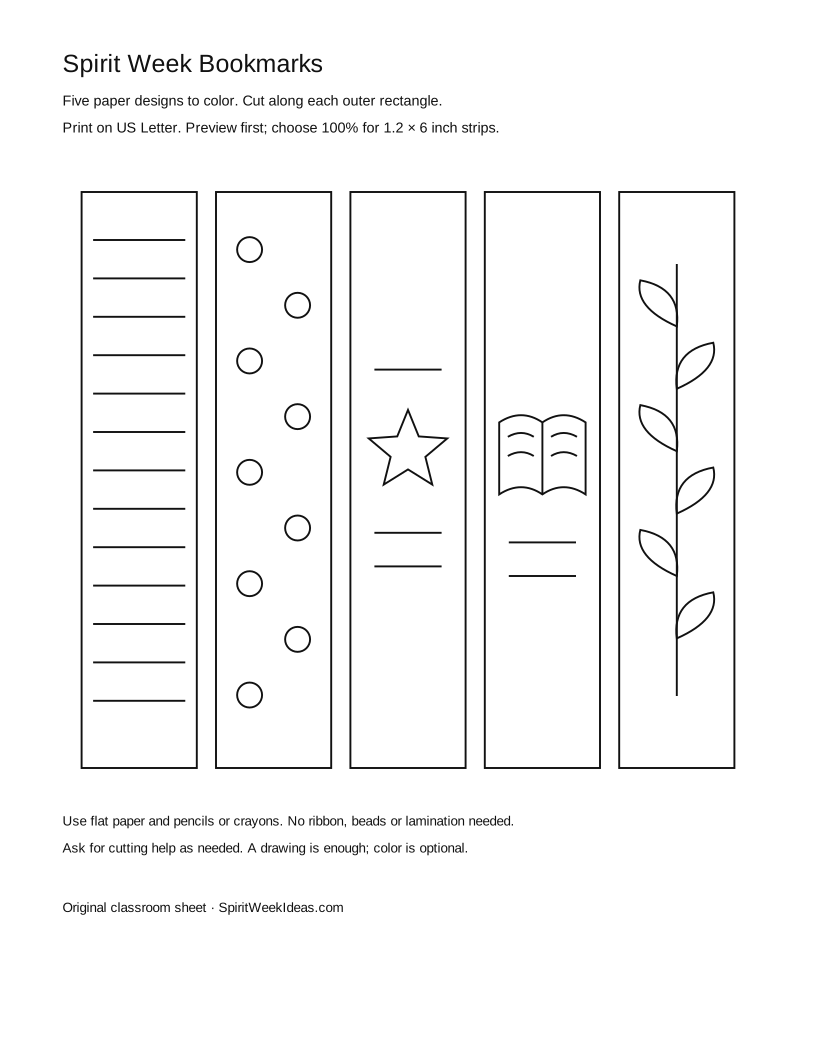
Open the SVG in a browser or an application that supports SVG printing. Preview the page before printing. The drawing is set up for US Letter; at 100% scale each outlined strip is 1.2 inches wide and 6 inches long. A printer’s fit-to-page option may change that size. Exact dimensions are not necessary for the classroom activity.
The outer rectangles are the cutting lines. The sheet has generous page margins, and the art stays within those rectangles. Do a single test print before making a class set. If you prefer a different paper size or wider strips, use the designs as drawing prompts on blank paper.
Staff can pre-cut strips for students who need that support. Otherwise, decorate first and cut with the class’s ordinary scissors routine. Keep scraps collected so the table is ready for the next activity.
Finish with a page-saving check
Place the bookmark gently between two pages and close the book normally. Check that the strip lies flat. If a student adds a large folded edge or a bulky decoration, return to the flat-paper version for use in a classroom book.
A short label on the back can help students recognize their work, following the class’s usual naming practice. Do not require students to put private information on a bookmark that may leave the room.
Offer a plain-paper optionA student can draw one line pattern, write a small word or leave the strip undecorated. The useful object does not depend on finishing every printed shape.
For an optional follow-up, invite one sentence about the chosen design or a book the student would like to open next. The writing starters can support that extension. The inclusive planning guide has more ways to offer different forms of participation.
Add a small classroom project
Choose a theme, then offer a paper-based way to join.