Recognize a specific contribution
A spirit week certificate can mark a shared activity, a finished class project or an adult helper’s contribution. A useful certificate says who it is for, what happened and when. It does not need a trophy title or an award for the most elaborate outfit.
The three templates below are original suggested wording. Replace the bracketed fields with confirmed details, then shorten the text to fit your page. There is also a simple landscape SVG certificate with blank writing fields for any of the three purposes.
Choose the recognition approach before the event. If staff plan a certificate for every student in a class, prepare consistently and offer private delivery when appropriate. Do not make dressing up, buying an item or speaking in front of everyone the condition for receiving the class’s recognition.
For an ordinary thank-you message without a printed certificate, use the thank-you note templates. This article focuses on wording and preparing a named certificate.
Three certificate wording templates
These are selectable text templates. They are not records of actual students or helpers. Use the version that matches what staff intend to recognize.
Student activity certificate
Presented to [student name] for taking part in [classroom activity] during [event]. Thank you for [one specific contribution]. Presented by [staff name] on [date].
Use a contribution staff actually observed: suggesting a clue, describing a pattern, recording a team result or helping reset paper cards. A student can contribute in ordinary clothes or with communication support.
Shared project certificate
Presented to [group or class name] for creating [shared project] during [event]. Together, you [brief description of the group’s work]. Presented by [staff name] on [date].
Describe the project rather than claiming every member did the same task. For example, a group may have combined drawing, dictation, ideas and material preparation in one class sign.
Helper appreciation certificate
Presented to [helper name] in appreciation of [specific task] for [event]. Thank you for helping us [practical result of that task]. Presented by [staff or school name] on [date].
Keep the result concrete: preparing paper packs, organizing the supplied materials or resetting an activity table. Confirm names and details with the staff lead before printing.
Turn a general compliment into a clear sentence
Start with an action and the task it supported. “For recording the group’s three tower attempts” tells the recipient what staff noticed. “For being amazing” gives little detail. Keep the tone warm without inventing a contribution just to fill a line.
Here are three invented examples of short contribution wording: “suggesting a pattern for our class sign,” “reading the clues while a partner arranged the cards,” and “preparing six paper packs for the activity tables.” Use them only when they fit what actually happened.
A group certificate can say “for creating a shared paper display” without assigning every student an identical role. Students may have drawn, dictated, suggested, listened or taken part with support. The inclusive planning guide has more ways to make classroom activities flexible.
Keep recognition separate from game resultsA cooperative certificate does not need to call the group a winner. If an activity has a measured result, record that accurately on its result sheet; do not turn a guess, tie or unfinished test into a championship claim.
For example, the paper tower plan records standing tests and heights. A certificate can recognize the group’s testing and revisions regardless of which tower was tallest.
Use the blank landscape certificate
Download the printable SVG certificate
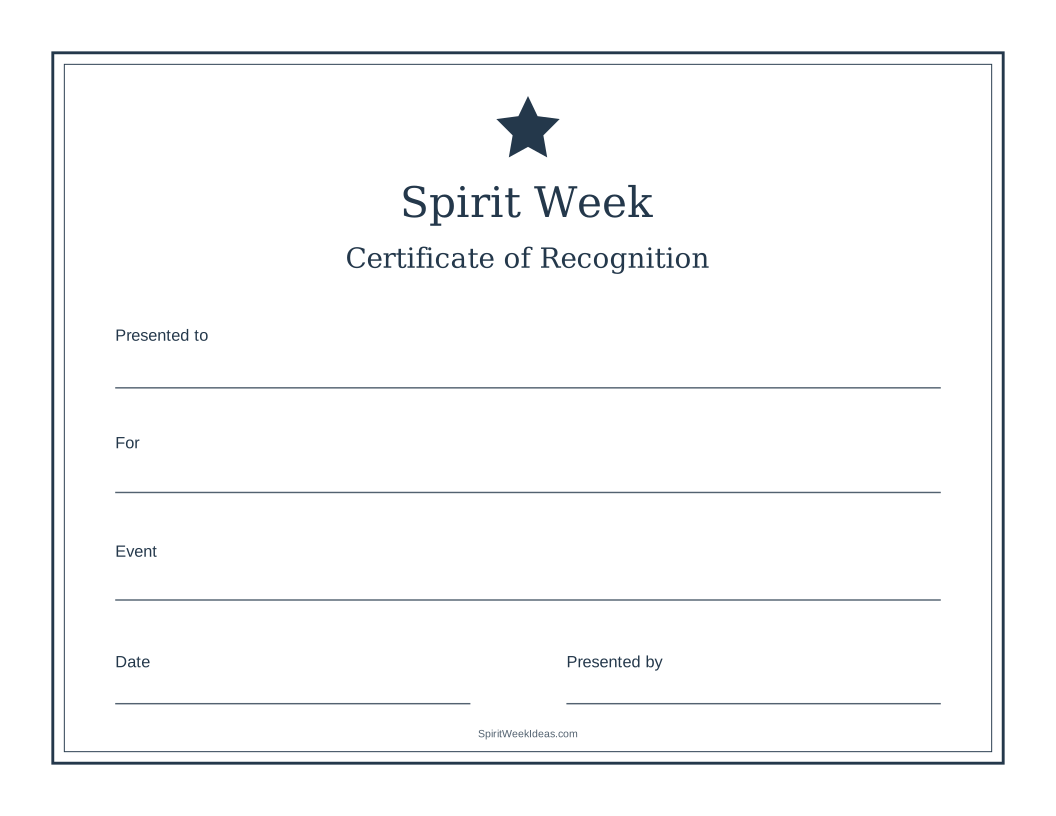
The original vector sheet has a navy border, a small star and spaces for recipient, contribution, event, date and presenter. Its page size is 11 by 8½ inches in landscape orientation. Print and write in the fields, or edit a copy in an SVG-capable editor.
Open the SVG in a browser or compatible print application. Select landscape paper and check the preview. Use a fit-to-printable-area setting if your printer would clip the border; scaling down changes the physical size but preserves the certificate’s proportions. Test one copy before printing a class set.
The SVG has blank writing lines rather than interactive form fields. It is not a PDF, and the illustrative certificate photographs are not exact previews of this downloadable design. The text templates are available separately if you prefer your school’s own certificate layout.
For a long name or contribution, write on a second line within the available space or shorten the contribution before printing a custom version. Keep the recipient’s actual name intact. Do not shrink the whole text until it becomes hard to read.
Check details before making a full set
- Confirm the purpose: student activity, shared project or helper appreciation.
- Verify the recipient’s preferred spelling through the school’s usual records or staff contact.
- Use the confirmed event title, date and presenter.
- Replace every bracketed field and check the contribution describes something that happened.
- Preview or test one copy, then count the final set and chosen spares.
- Arrange how completed certificates will reach recipients.
For an illustrative class of 24, one certificate per student plus three chosen blank spares means 27 sheets. A separate group-project certificate adds another sheet only if staff actually want that version too. The three templates are choices, not three required certificates for each person.
For helpers, check the assignment with the staff lead rather than assuming the person performed every job listed on the volunteer briefing. Use the task they completed and a practical result staff can confirm.
If you use a group name, match the spelling on the team label and the project record. Keep the event name consistent with the family schedule so recipients know which activity the paper refers to.
Plan a calm handoff and corrections
A short classroom acknowledgment or direct handoff can be enough. Ask before displaying a student’s work or reading a personal contribution aloud, and follow the school’s usual arrangements for sharing names or photographs. A certificate does not require a public ceremony.
Set aside certificates for absent recipients and use the school’s ordinary way of getting papers home. If a name is wrong, replace the certificate without asking the recipient to keep an error. Blank spares can help with a last-minute correction.
For a shared class certificate, choose an approved display location or let staff keep it with the project. Do not assume one paper can also serve as an individual take-home copy for every member.
If another teacher will distribute the set, note where it is stored, which version is intended for whom and who can correct an error in the staff handoff. Use the school’s normal staff records for recipient details rather than a public list.
Save the wording and preparation sheet
Download the editable certificate wording pack
The plain-text file includes all three templates, example contribution phrases and the preparation checks. It is not a fixed-page certificate design. Copy the version you need into your preferred document, replace the placeholders and preview the result.
The printable SVG provides a separate blank design to complete by hand. Choose either route based on the actual job: a few handwritten certificates or a formatted class set. Keep the wording specific, the names accurate and the recognition consistent with the event’s participation options.
Choose a theme for a shared activity
Browse ideas and prepare a simple class plan.