Download the puzzle and answer key
Find 12 spirit week words in a square letter grid. Words read left to right, straight down or diagonally down to the right. Each listed word appears once, and none runs backward. Use the puzzle as a quiet arrival activity, a short station or a shared search with a partner.
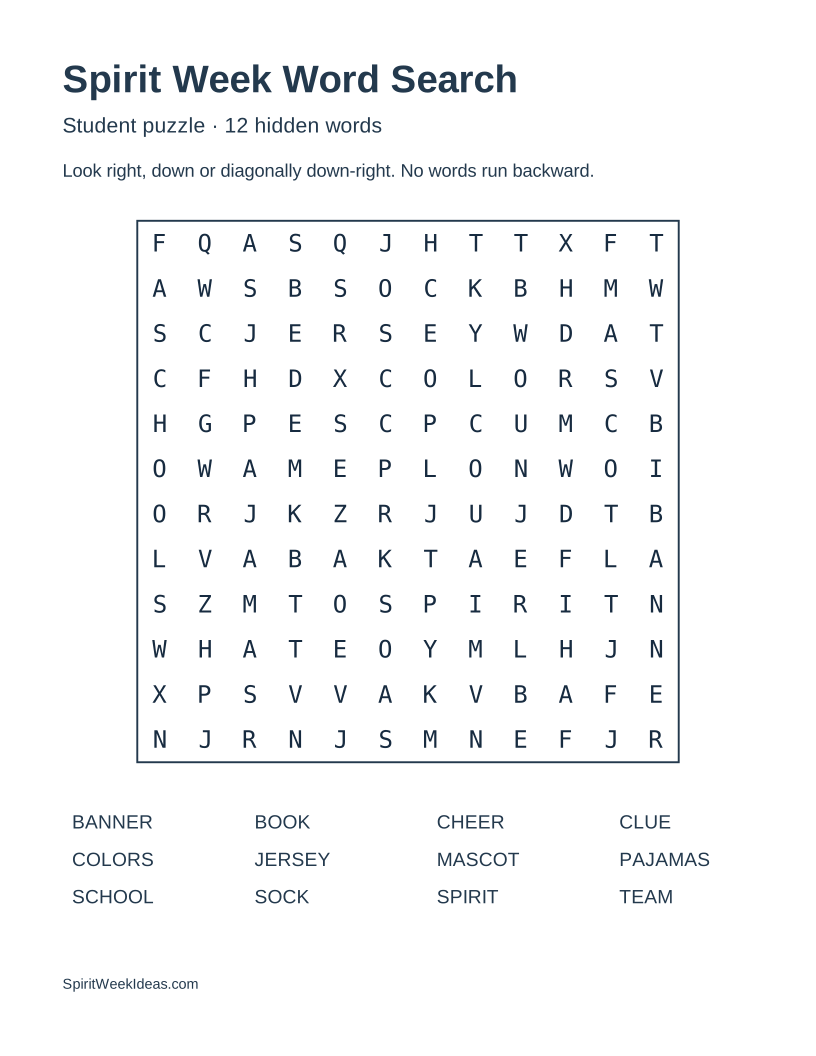
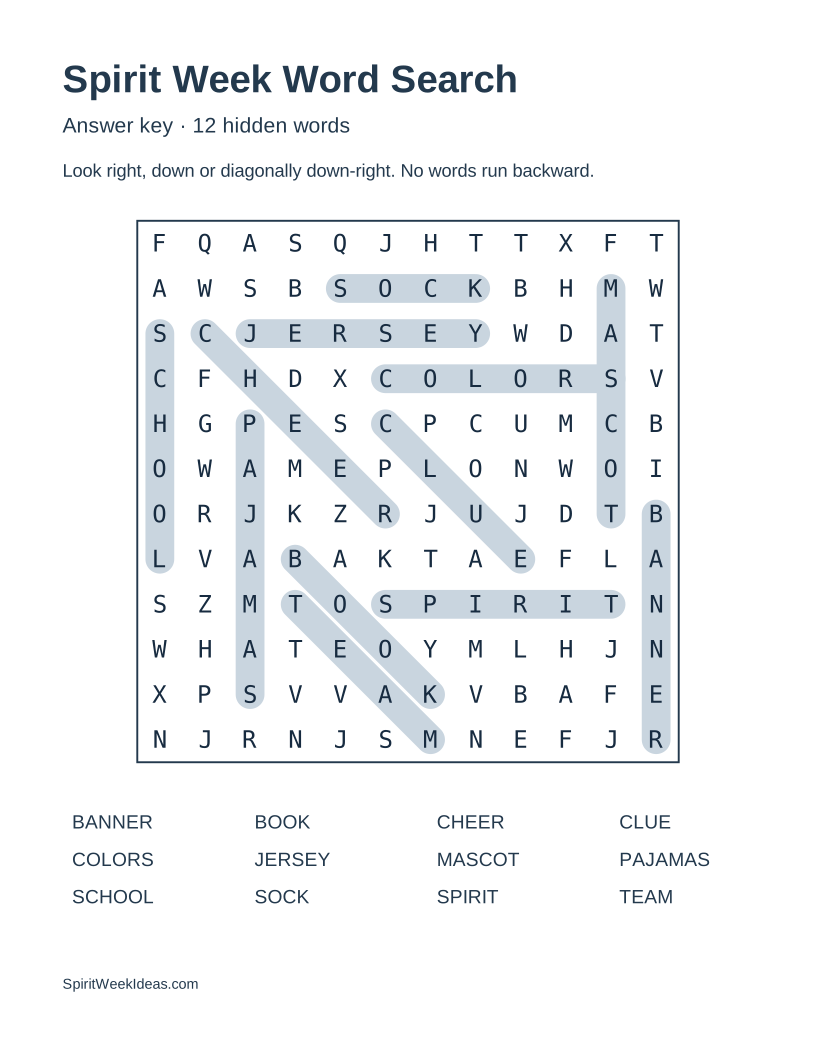
Both files are set up for US Letter in portrait orientation. Open the file in a browser or an application that supports SVG, then check print preview. If the border is clipped, select a fit-to-page option. Print one student copy first to check that the letters and word bank are easy to read. The photos illustrate the activity; the linked student sheet is the actual puzzle.
Read the 12-word bank
Read the list together before starting. You can explain BANNER as a large sign or MASCOT as a character or symbol that represents a group. Students can solve the puzzle whether or not they dressed for a theme.
- School and teamwork: SPIRIT, SCHOOL, TEAM, CHEER
- Signs and clues: COLORS, BANNER, MASCOT, CLUE
- Theme details: JERSEY, PAJAMAS, BOOK, SOCK
Connect the word bank to the day if it fits. BOOK can lead into a book-themed activity, SOCK into Wacky Sock Day, and JERSEY into Sports Day. The puzzle stands on its own if your week uses different themes.
Set up a short round
- One student puzzle per person or pair.
- A pencil for circling words and crossing them off the bank.
- One staff copy of the key, kept separate from the student sheets.
- An agreed stop point, even if some words are still hidden.
For 24 students working in pairs, print 12 puzzle copies plus any spares you choose. Keep a single key for review. Try two minutes to explain, five minutes to search and three minutes to compare findings. Treat that ten-minute outline as a short round, not a deadline to find every word.
If printing is inconvenient, display the student SVG and invite the class to point out a start cell and direction. Mark the answer on a separate copy or trace the path with a pointer.
Show how to follow a path
Pick a word from the bank. Find a possible first letter.
Check the next letter to the right, below or down-right. Follow the same direction for the rest of the word.
Circle the whole path only after all letters match. Cross the word off the bank so it is easy to see what remains.
For a demonstration, use the letters S–O–C–K on the board without giving away the actual grid location. Show how a path that bends or skips a cell cannot count. In pairs, one student can locate a possible start while the other checks the letters. Switch jobs when useful.
Give a clue that leaves something to solveUse the key to point to the correct row or name the direction. Let the student follow the letters from there before showing the full path.
Adapt the search without adding a race
Start with a short set such as BOOK, SOCK, TEAM and CLUE. If diagonals are new, begin with SOCK and JERSEY, which both read across. A blank sheet can cover unused rows while a student checks one row. Move it aside when looking down or diagonally.
Offer an enlarged copy or read letters aloud while a partner traces a chosen path. A student can describe a start cell or check a word without holding the pencil. Use the class’s usual supports, and let students stop after the selected words. The inclusive spirit week guide has more participation options.
At the end, show a few paths from the key and invite students to explain how they checked them. A pair that finds four selected words has completed the shorter task. There is no need to rank pairs by speed or by total words found.
Use the puzzle as a station or follow-up
For a classroom station, leave the student sheet, pencil and selected words together. Take completed copies away between groups so the next group starts with an unmarked grid. If another teacher will lead it, record the shorter word list, print location and review plan in the staff handoff.
For a different word task, use the word scramble pack. In that game students rearrange letters; in this one they trace letters already in order. Or ask a willing pair to hide one new word in a small practice grid and verify its path before sharing it.
Choose a theme for a shared activity
Browse ideas and prepare a simple class plan.